
Seed-Applied Insecticides in Cotton After the Neonicotinoid Debate: Indian Practice and Plant Stand Economics
Europe restricted neonicotinoid seed dressings over bees; India did not, and the seed dressing is still the first insecticide decision of a cotton season. What the Indian seed-treatment trials, the CICR resistance monitoring and the Guntur and Kurnool IPM economics actually measure, and why the seedling window rather than the spray diary decides plant stand and yield.
Seed Treatment in Indian Mustard: Alternaria Blight, White Rust and Early Vigour in Rajasthan and Madhya Pradesh
Mustard is dressed before sowing as a matter of routine, but the two diseases that decide the crop are not equally reachable from the seed bag. White rust has an established seed-treatment answer; Alternaria blight does not, and India's package of practice still manages it with mancozeb sprays. What the Rajasthan and Madhya Pradesh trials, the AICRP disease surveys and the seed-priming work actually show for a crop sown at four to five kilograms per hectare.
Seed Treatment for Direct-Seeded Rice: What the Shift Away from Transplanting Actually Demands of the Seed
Direct seeding removes the nursery, the puddle and the standing water, and with them three things that quietly protected the Indian rice crop. PAU Ludhiana recorded 7-11% yield gains from potassium nitrate and gibberellic acid seed priming in DSR; Haryana's bakanae survey found dry sowing carried less disease than sprouted seed in puddled beds; a Warangal imidacloprid trial controlled thrips for a month and changed no yield.
Trichoderma or Carbendazim? What Two Indian Field Trials Actually Show for Chickpea and Pigeonpea Wilt
ICAR-IARI cut chickpea wilt to 12.5% where carbendazim left 30%, using a biopolymer-carried Trichoderma seed treatment. At RPCAU Pusa, two Trichoderma isolates did worse than the fungicide on pigeonpea. What separates the results is strain selection and carrier chemistry, not biology versus chemistry.
Boosting Groundnut Yields with Multilayer Biopolymer Seed Coating: An ICAR–IIOR Validated Technology
How ICAR–IIOR's multilayer biopolymer seed coating—commercialised as Seed Primer—delivered a 27.5% yield gain and a 46% improvement in benefit–cost ratio for groundnut farmers in Telangana.
SeedPrimer with Trichoderma: ICAR-Validated Disease Control and Yield Gains across Safflower, Groundnut, and Soybean
Two years of multi-location ICAR-IIOR field trials and on-farm grower validation confirm that SeedPrimer's patented bio-polymer film, integrated with Trichoderma harzianum Th4d, delivers measurable improvements in germination, disease suppression, seed yield, and farmer profitability across safflower, groundnut, and soybean.
When Biology Beats Chemistry: SeedPrimer's Trichoderma Coating Outperforms Industry-Standard Fungicides on Castor
A field-ready challenge to the fungicide status quo, validated by ICAR-IIOR. In vitro evaluations show Trichoderma harzianum Th4d, the active SeedPrimer is engineered to deliver, outperforming Carboxin+Thiram, Penflufen+Trifloxystrobin, and matching Propiconazole across castor's three major pathogens.
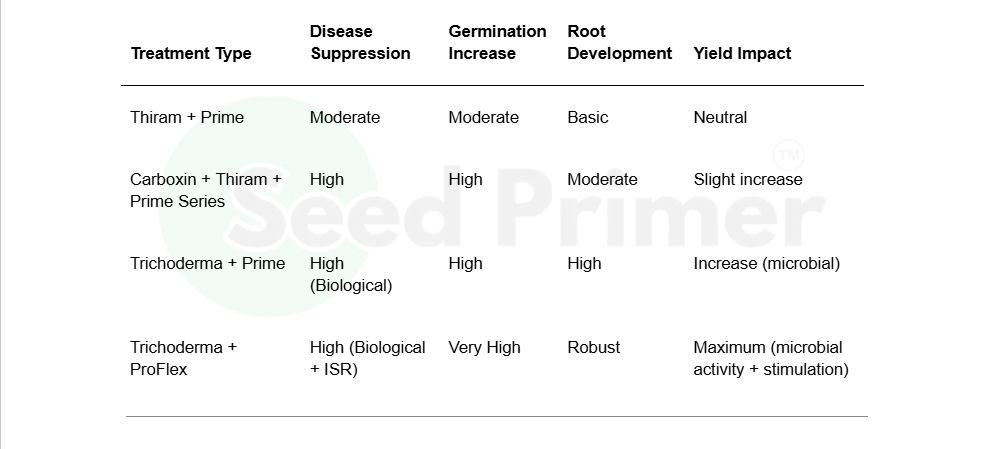
Optimizing Pre-Packaging Seed Treatments for Paddy (Rice) in India
A Scientifically Grounded Framework for Seed Treatment Optimization